Your expertise needs an aqueduct.
Great financial advisors possess enormous reservoirs of knowledge: years of client conversations, planning judgment, and hard won perspective. Segovia is the system that keeps those ideas flowing, instead of sitting still.
Your expertise is the Source. Sherpa builds the flow.
Finding the water was never the hard part.
Carrying it was.
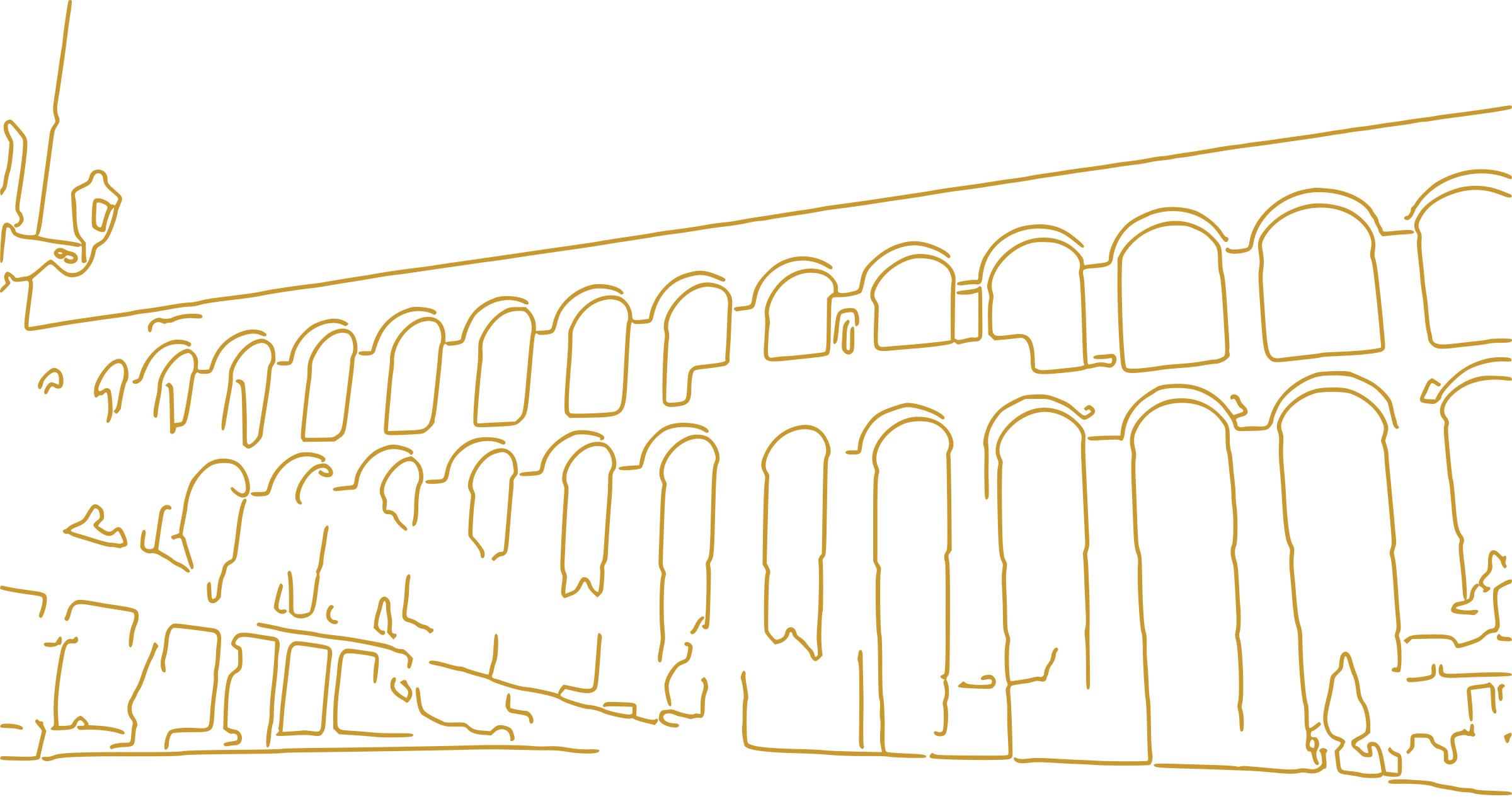
Just outside the city of Segovia, Spain, Roman engineers built one of the most enduring aqueducts in the world. It was a stone channel that ran for miles, carrying water from a mountain spring to a city that needed it. The spring itself wasn't the achievement. Mountain springs are common. What made Segovia remarkable was everything built after the water was found: the arches that carried it across valleys and ravines, a gradient calculated so precisely that gravity alone did the work, and the castellum. It was a distribution tank at the city's edge that split the flow fairly among fountains, baths, and homes.
Without that infrastructure, the water at the source meant nothing. It would have stayed exactly where it was, in a mountain nobody visited, doing no one any good.
An advisor's expertise works the same way. The knowledge is real: the planning philosophy, the client instincts, the hard earned point of view. But knowledge that stays in your head, or surfaces only in one conversation at a time, never reaches the people who need it. It needs infrastructure to carry it, and a distribution system to deliver it. That's what the Segovia Method is built to provide.
Your expertise is the Source.
Everything starts here.
Every advisor carries more raw material than they realize. Client questions answered a hundred times. Judgment calls made under pressure, and the instincts that came from making them. A planning philosophy shaped by years of watching decisions play out over decades, not quarters. A niche understood more deeply than any generalist could manage. Interpretation of markets and headlines that clients actually trust, because it's coming from someone who knows them. Stories that make a complex idea click in five sentences. Research nobody else has bothered to do. Beliefs the advisor holds strongly enough that they shape every recommendation. None of it is content yet. It's just Source.
Content is the infrastructure.
Not the finish line.
An aqueduct's arches did the unglamorous work: carrying water across terrain that gravity alone couldn't cross, in a steady, dependable rhythm. Sherpa's arches are the content infrastructure that does the same job for your expertise. They're built on a cadence, not created from scratch every time inspiration strikes.
Distribution is not an afterthought.
The Castellum manages the distribution.
In Rome's water system, the castellum divisorium sat at the city's edge, where the channel finally arrived. Its job wasn't to make more water. It was to divide the flow that already existed, fairly and reliably, among fountains, baths, and private homes. Nothing reached the city by accident. Every destination was a deliberate decision made upstream.
Most advisor marketing skips this step entirely. Content gets created, then posted wherever is convenient, whenever there's time. Sherpa treats distribution as its own discipline. It puts as much thought behind where an idea goes as behind writing it in the first place.
Website
Newsletter
People cannot trust what they don't recognize.
And they can't recognize what they rarely encounter.
In 1968, psychologist Robert Zajonc ran a series of experiments and found something that still surprises people: mere repeated exposure to something, such as a word, a face, or a shape, made people rate it more favorably, even when they couldn't consciously recall having seen it before. No argument was made. No case was won. Familiarity itself did the work. Researchers have since replicated the effect across faces, brands, music, and political candidates. It's one of the most consistent findings in social psychology, and it holds a particular relevance for financial advisors.
Almost no one hires a financial advisor after a single encounter. The decision is too consequential, and the trust required is too specific. So trust accumulates in small, low pressure moments instead: an email opened at a desk, a LinkedIn post scrolled past on a commute, an article read while waiting for an appointment. No single moment persuades anyone of anything. But across enough of them, a name stops being unfamiliar. Then the thinking behind it becomes familiar. Then that thinking becomes associated with a specific kind of expertise. That's the mechanism repeated meaningful exposure is built to activate. It's not manipulation, just enough legitimate contact for real expertise to be noticed.
"I've come across them."
"I know that name."
"I keep seeing how they think."
"That's who understands this."
"They clearly know this subject."
"I'd be open to a conversation."
Repeated meaningful exposure doesn't replace expertise. It gives real expertise the repeated chances it needs to be seen, understood, and eventually trusted.
A city with water is alive.
A practice with reach is too.
Every arch, every distribution decision, every repeated encounter exists to serve one outcome: an advisory practice where the right people keep encountering the right expertise, until relationships form and deepen on their own. That's a city alive. It's not a content calendar; it's a living, working system.
Clients engaged.
Prospects educated.
COIs informed.
Referrals strengthened.
Conversations created.
Relationships developed.